
 15 hours ago
1
15 hours ago
1

‘Bless their little cotton socks!” is not a response one expects to have to any of the inhabitants of Westeros, the land of the bloody, violent, incestuous and often depraved series of Game of Thrones. But the endearing protagonists of the latest spin-off of the franchise, A Knight of the Seven Kingdoms, invite it.
Their names, as in the George RR Martin novellas on which the series is based, are Dunk – short for Ser Duncan the Tall – and Egg. Dunk (Peter Claffey, a suitably tall former Irish rugby union player, last seen in Bad Sisters) was squire to a hedge – non-noble – knight, Ser Arlan of Pennytree (Danny Webb), who took the boy under his wing but never quite got round to knighting the man before dying. We first meet Dunk burying his mentor under an old elm tree and taking up his arms against the sea of troubles that are about to engulf him. Dunk is a simple soul (very simple, some might say – he may look like a medieval Jack Reacher, but inside he is more of an eager but baffled labrador) and sets out to find a lord he can himself serve as a hedge knight.
Fortunately, one of his early pit stops is at a tavern that brings him into the orbit of the bald-headed, ethereal-looking, rovingly intelligent child Egg (Dexter Sol Ansell, a mighty screen presence in a tiny frame and quite fascinating to watch). Egg offers to be Dunk’s squire (“You look like you need me the most”) and off the underdog and underpuppy go through the back roads of Westeros, 100 years before GoT, with the Targaryens on the Iron Throne and some familiar surnames floating around elsewhere, towards a jousting tournament that might provide Dunk with the win and mentor he needs.
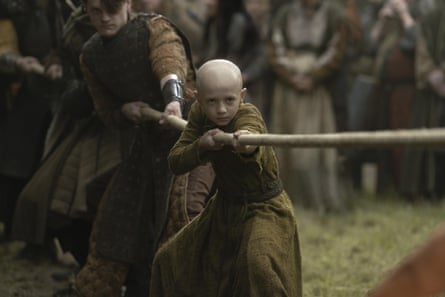
In Game of Thrones franchise terms, A Knight of the Seven Kingdoms is a bagatelle. If House of the Dragon was born of a desire to turn the tide of fans’ anger over the original’s finale (or final season. Or final seasons. Discuss animatedly until even Jon Snow is bored to death) while keeping the appetite for more alive until GRRM had completed his masterwork, this new offering seems to be something quite different. What this means for our collective hopes for the two remaining books in the sequence, let us not dwell.
One of the most obvious points of departure is that while GoT burned through plot like Maester Pycelle’s wildfire through Stannis’s fleet, very little happens in the average episode of AKotSK (which comes in at about the 30-minute mark instead of its progenitor’s full and weighty hour). We are here for the budding friendship between knight and squire, even if it is not always clear – given Egg’s much greater knowledge of how the world works than dear old Dunk’s – which way round those roles are allocated, and a level of emotional investment in the pair that it would have been frankly foolish to apply to any of the characters in GoT once we saw what they did to Ned Stark.
It’s not exactly entry-level stuff – there is too much swearing, too many inventive tortures (albeit more often graphically described than shown in full and granular detail as was traditional), plus a bit of full-frontal male nudity that … raises questions. Plus, later on, there is an episode too full of gore for the series to be safely shown to unsupervised non-Eggy children. But it is a much, much gentler proposition than either Game of Thrones or House of the Dragon. Instead of severed peens we get Dunk bumping into lintels. Instead of Red or Purple or Sansa’s weddings, we have averagely drunken nights in taverns. Instead of sons being served up in pies we have no sons being served up in pies. It’s much more restful. And there’s no Ramsay Bolton, save still in your nightmares.
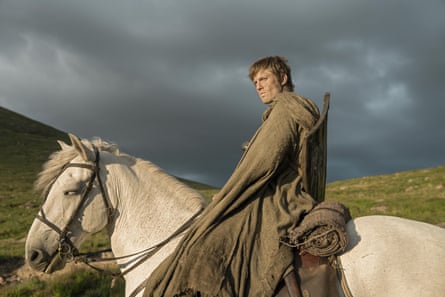
Which does rather make you wonder who the target audience is? Not children, who might otherwise warm to this tale of a bumbling adult periodically saved by the wise child at his heels. Not epic fantasy fans jonesing for the next instalment of A Song of Ice and Fire (though dragons exist in living memory, this era of early Westeros is free of magic and sorcery). And although it gestures towards larger questions, like the corruption of innocence and the pros and cons of the feudal mentality, it doesn’t delve into them deeply or carry enough weight on its own to attract a great audience of non-diehard GRRM fans.
But perhaps the fact that it is not going to set the world on fire, either literally within the show or metaphorically without it, is the point. The real world is now too Westeros-like for us to cope with any more. The land of fabled violence is now our safe space. We are all Dunk, just hoping for protection from even something as fragile as an Egg.




 English (US) ·