
 16 hours ago
1
16 hours ago
1

After Portugal had beaten England in the World Cup quarter-final in 2006, Cristiano Ronaldo was asked how he had looked so calm taking his penalty in the shootout when England’s players appeared crushed by the occasion. For a moment he seemed baffled by the question, then he explained that those moments are what he lives for. Where others feel pressure, he sees opportunity.
What, you wonder, did Brahim Díaz see during the Afcon final on Sunday? When his shoulder was tugged by El Hadji Malick Diouf and he collapsed, did he consider the consequences? When he howled in the face of the Democratic Republic of the Congo referee Jean-Jacques Ndala Ngambo as he waited for the verdict of the video assistant referee, did it occur to him he would take the penalty if it were given? He had scored one against Mali in the group stage, but that was with Achraf Hakimi, a very fine penalty taker, off the pitch.
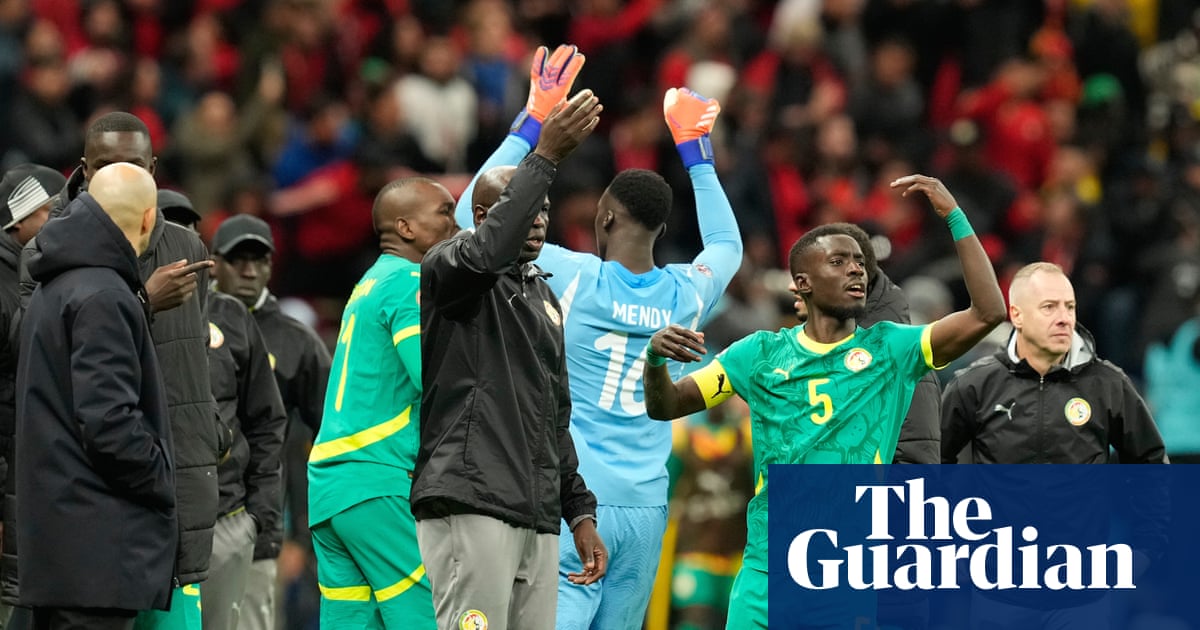
Perhaps if Díaz had taken it immediately, after Ngambo had reviewed the incident on the screen and pointed to the spot, adrenaline would have carried him through. But instead he had to wait 15 minutes as Senegal left the pitch in protest before Sadio Mané persuaded them to return.
What went through his head then? Against Mali, he had sidefooted his penalty low to his left, as the goalkeeper, Djigui Diarra, went the other way. Did it occur to him that Édouard Mendy, the Senegal keeper, would have seen that? What game of bluff and counter-bluff played out in his mind as he waited, not knowing when – or even if – Senegal would return.
At some point, he decided on a Panenka. There have been those who have criticised him for opting for such a high-risk penalty at such a crucial moment. But then, the original, taken by Antonin Panenka to win the shootout for Czechoslovakia against West Germany in the final of the 1976 European Championship was at just such a crucial moment.
Panenka’s logic was that a high-pressure moment was the perfect time to try it because the goalkeeper would never expect it. That was 50 years ago, three months after Morocco won their first, and only, Cup of Nations. The world is more familiar with dinked penalties. Was Díaz trying to win the competition with a flourish? Or did he simply think that was the best way to score, that Mendy would dive one way or the other?
He kissed the ball, placed it on the spot. He walked back. Looking at the replay, he perhaps seems to be blinking more than usual, but that may be an observation shaped by knowledge of what was to come guiding the perception. He blew out his cheeks, approached the ball … and slowed down.
Panenka insisted the deceleration should come at the last, not in the run-up, but in the strike. Díaz duffed the kick.
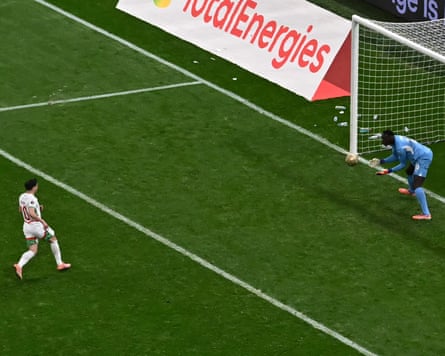
It wasn’t even a good Panenka. Even if Mendy had been fooled, there is a chance he might have been able to save it with an outstretched leg.
But he was not fooled. Five years ago, Mendy saved a Panenka from Sergio Agüero in a league game for Chelsea against Manchester City. He did it again, catching the ball so easily many wondered whether Díaz missed on purpose, whether some deal had been done to get Senegal back on the pitch. There was a strange calm as the ball dollied into Mendy’s grasp. Nobody celebrated. But the forward’s evident devastation told its own story.
“Do you really believe that with one minute left, when a country has been waiting for this for 50 years … do you think we would agree on something?” Mendy said. “He wanted to score, I get the credit for stopping it, that’s all. Let’s put an end to this. Díaz tried to score, and I just did my job. I stayed calm facing that Panenka and managed to save it. It’s time to close this debate.”
Poor Díaz must now live with that. He was the tournament Golden Boot winner, scoring five times, but it was the sixth he did not score that will be for ever remembered, his award now a dread reminder of failure.
His coach, Walid Regragui, was unsympathetic. “We stopped the match in the eyes of the world for 10 minutes,” he said. “That didn’t help Brahim. That doesn’t excuse Brahim for the way he hit the penalty. He hit it like that and we have to accept it.”
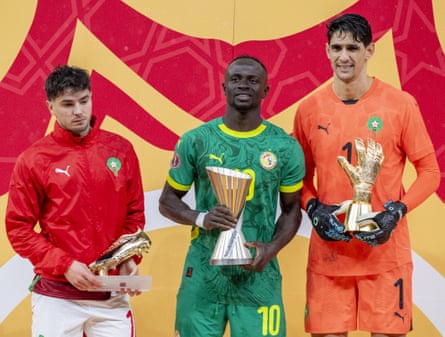
Díaz was in tears as he left the pitch and reports suggest he was inconsolable in the dressing room.
Moroccan newspapers were united in their criticism. Al Mountakhab said he had taken the kick “very badly” and Al-Alam spoke of “inexplicable carelessness”. While Al-Massae preferred to condemn Regragui’s “tactical approach” it made clear the scale of the defeat, describing the “tears of regret of millions of Moroccans”.
As Regragui observed, football is often a cruel game. For seven games, Díaz excelled, but his tournament will be defined by one incident 23 minutes after the scheduled final whistle. His task is to ensure it does not also define his career.



 English (US) ·