
 3 hours ago
2
3 hours ago
2

Attendance: up. British winners: up. Bookies’ profits: through the roof. Punters will wince at the last of those after a ferociously difficult four days at Cheltenham, with winners at 66-1, 50-1, 40-1 and 33-1 among the biggest skinners for the books. The Paddy Power client in Ireland who was paid €558,000 (£484,000) after putting Friday’s first six winners into a 50 cent each-way Lucky 63 would be a very worthy inductee into the Cheltenham Hall of Fame.
With the betting blinkers off, though, this was very much a bounce-back festival, for the track and British racing as a whole after three years of declining crowds and a decades-worth of embarrassing pastings for the home team at the hands of the Irish.
The 3.7% rise in attendance over the four days, 8,130 extra tickets sold, is modest, but encouraging. It was perhaps a case of going for the low-hanging fruit as the biggest jump, from 41,949 to 46,317, was on the second day, which was in danger of dipping below 40k on recent trends. A rebrand as Ladies’ Day contributed to a 10% rise and you can be sure Cheltenham’s marketing department will be working the database with added zeal over the coming months to build further back towards 50,000 next year.
The week’s total of 13 British-trained winners exceeded the most optimistic predictions. The home side certainly fancied their chances of improving 2025’s eight wins, but an additional five, which put them in with a chance of a tie until Henry de Bromhead took the Martin Pipe Handicap Hurdle at the end of Friday’s card, was at least two beyond any reasonable expectation.
Greg Wood's Monday racing tips
ShowPlumpton 2.15 Escort’kheops 2.45 Kool Kid 3.15 Risk It All 3.45 A Tickatickatiming 4.15 Ferret Jeeter 4.45 Ghasham 5.15 Secret Des Lune
Ffos Las 2.30 Rest Is The Best 3.00 Port Or Starboard 3.30 Whiskey Yankee 4.00 Genietoile 4.30 Sioux Falls 5.00 Port And Brandy
Wolverhampton 5.30 Magnetude 6.00 Lhebayeb 6.30 Ted Le Saux 7.00 Corniche Girl (nap) 7.30 Twilight Madness 8.00 Moonhall Lass 8.30 Crown The Future (nb)
It was refreshing, too, for the British successes to be spread around, with nine yards getting a winner on the board. But there was still no one within hailing distance of Willie Mullins, who returned home to County Carlow with eight winners, six seconds and three third-place finishers. His haul included a rare treble in the meeting’s most prestigious feature events – the Champion Hurdle, Champion Chase and Gold Cup – with Lossiemouth, Il Etait Temps and Gaelic Warrior, and the same three winners, plus King Rasko Grey’s success in a controversial opener on Wednesday, were also enough to give Paul Townend the top-jockey prize for the fifth year running.
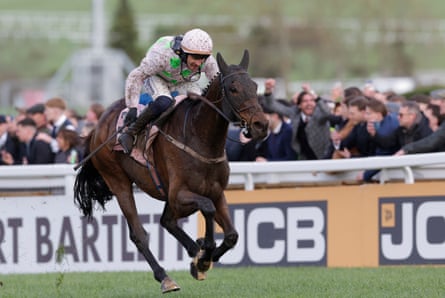
The extraordinary wall of noise as Old Park Star, the favourite, reeled in Sober Glory on the hill in the opening Supreme Novices’ Hurdle on Tuesday is one of the abiding memories of the week and Nicky Henderson’s latest Supreme winner, joining a list that includes Altior, Shishkin and Constitution Hill, promises to be one of the biggest stars of next season if, as expected, he moves on to chasing with the Arkle Trophy as a long-term aim.
Lossiemouth and Gaelic Warrior were hugely popular winners while a personal highlight was seeing the delight of Adam Nicol and the connections of Minella Study after his run into third place in the Triumph Hurdle. “Willie Mullins had eight in the race and we beat all but one of them,” he said. “He’s got more running today than I’ve got in my yard.”
There were inevitable downs alongside the ups. Footage of a brawl in the William Hill betting shop on Tuesday, which went viral on social media, was an ugly reminder of how readily a tweet can leave a lingering mark on the sport’s image.
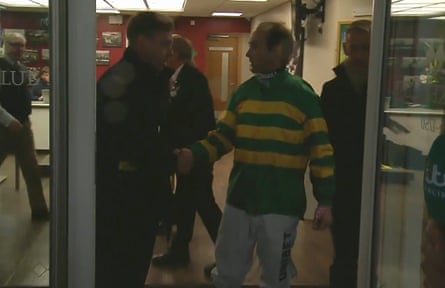
Wednesday’s spat between Declan Queally and Nico de Boinville before the start of the Turners Novices’ Hurdle, which led to a complaint of racist abuse against De Boinville, was the most obvious manifestation of issues that plagued the starts all week, leading to one false start after another.
The British Horseracing Authority announced midweek it would conduct a review of starting procedures once the meeting had concluded and also seems intent on pursuing Queally’s complaint, despite the two riders having appeared to resolve their differences with a handshake on Thursday afternoon.
The lowest point of the week, and a dismal postscript to a thrilling Gold Cup, was the death of Envoi Allen a few minutes into retirement, having just competed at the festival for the eighth year in a row.
Envoi Allen, who collapsed and died on the walkway back to the unsaddling enclosure, was one of four horses to die either during or just after competing at the festival, from 475 runners.
Saint Le Fort and HMS Seahorse suffered fatal injuries in last-flight falls in hurdle races, while Hansard broke down between the third-last and second-last fences in the Arkle Trophy. None of the fatalities were the result of a fall in a steeplechase.
James Given, the BHA’s director of equine health and welfare, confirmed on Friday evening that Envoi Allen, like all finishers at the meeting, had been “looked at and passed fit to come down the walkway”. Like all festival runners, “he had the normal pre-race examination, had his heart listened to, was trotted up, his limbs were checked.”
Envoi Allen is believed to have suffered an “acute cardiovascular collapse”. In jump racing, Given told the BHA’s X feed on Friday, this occurs in “nine per 10,000 starts, a very rare event”. Even so, it is still “something we are studying to find out more about it,” Given added. “We are the first country in the world to allow heart monitors to be worn on horses while racing, and we’re learning stuff we didn’t know even a year ago.”
The Royal Society for the Prevention of Cruelty to Animals (RSPCA) subsequently issued a statement on Saturday which said that the organisation was “deeply saddened” by the equine fatalities. “The deaths … mean 24 horses have lost their lives in competitive racing in the UK this year alone. One death is too many – but the scale of fatalities reiterates the urgency that lessons must be learned – including what caused the loss of life, decision-making during the race, and any future means of prevention.
“These incidents are clearly at odds with the UK’s status as a nation of animal lovers. The RSPCA remains concerned about racehorse welfare, so we continue to engage with the industry to advocate for further improvements, including the introduction of greater safety measures, and improvements for equine welfare both on and off the track.”
The RSPCA is (or should be) well aware racing has successfully invested many millions of pounds to drive down the number of fatal injuries – over jumps in particular – in recent years and continues to do so. Any athletic activity, meanwhile, comes with a risk of injury that can never be eliminated entirely, and the 24 fatal injuries referenced in its statement are from 14,230 starts so far this year – an overall rate of just 0.17%, or between one and two for every 1,000 starts.
So while the overall mood is one of positivity after the 2026 festival, it should be a concern for the sport’s executives that there are echoes in the RSPCA’s statement of the language used by more hardline animal rights groups, which campaign for an end to all use of animals by humans.
With the Grand National next up in the busy spring calendar, a robust response to highlight racing’s welfare efforts, both in public and behind-the-scenes, should perhaps be a priority on the sport’s post-festival checklist.





 English (US) ·