
 13 hours ago
3
13 hours ago
3

The decision by four European broadcasters to boycott next year’s Eurovision over Israel’s inclusion is undoubtedly a watershed moment in the 70-year history of the song contest.
One of the few genuinely popular, non-elitist and pan-European cultural events will be without Spain, one of the “big five” nations in terms of financial contributions; Ireland, which has won the contest more times than any other country bar Sweden; the Netherlands, a 1956 founding member; and Slovenia, symbolic of the EU’s eastward enlargement.
And with only a shaky ceasefire in Gaza, and Israel’s broadcaster KAN showing no sign of retreating of its own accord, this may well be the state of play for some time to come.
At the same time, political boycotts are anything but new to the world’s largest live music event, whatever its organisers say about the competition’s supposedly apolitical nature.
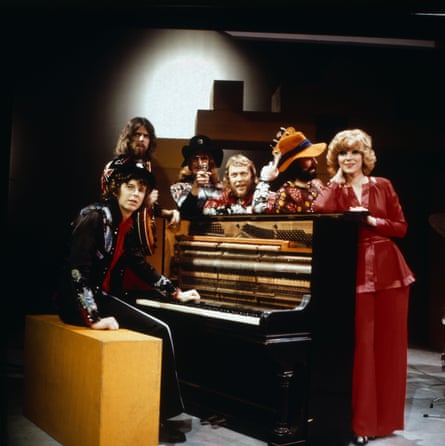
“Greece and Turkey have boycotted the event, in 1975 and 1976 respectively, over Turkey’s invasion of Cyprus,” said Paul Jordan, a cultural historian who was part of the international jury for the French national selection for Eurovision in 2019. Armenia refused to take part when the 2012 event was held in Baku, Azerbaijan.
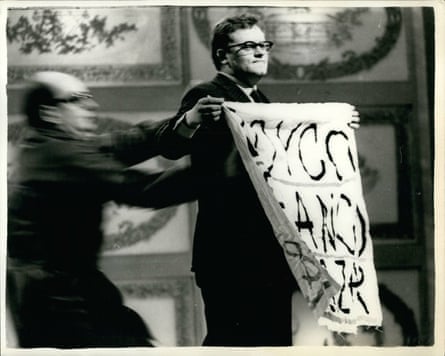
Ironically, it was Spain, whose broadcaster RTVE has been the most outspoken of the four boycotters, that was a target of the first boycott call in the competition’s history. At Eurovision’s ninth edition, in Copenhagen in 1964, a young Danish leftwing activist stormed the stage with a placard that read “Boycott Franco & Salazar”, to protest against Spain and Portugal being allowed to compete in spite of them being run by military dictatorships.
Spain won Eurovision in 1968 and got to host the 1969 contest, which was boycotted in protest against the Franco regime by Austria – which will be the 2026 hosting nation and is one of the countries now most scandalised by the breakaway four’s boycott.
You might say all this means Spain’s activist stance smacks of hypocrisy, or you could say the country is in a stronger position to gaze through the dry fog and glitter and see what Eurovision is really all about.
“Spain entered Eurovision just after it was blocked from joining the European Economic Community – it was about ending its ostracism and entering an elite club”, said Duncan Wheeler, the chair of Spanish studies at the University of Leeds. “Its own history in Eurovision has made it acutely aware of how pop culture can function as a soft power.”
Given the “Euro” in the title, some will ask what right Israel ever had to a starting place in the song contest in the first place. That would be to misunderstand the origins of Eurovision, which was never designed as a top-down vehicle for building a common European culture, but as a fairly mundane experiment in cross-border broadcasting that gained political meaning almost by accident.
One frequently overlooked fact is that not only Israel but also north African and other Middle Eastern countries including Algeria, Lebanon, Libya, Morocco and Tunisia are full members of the European Broadcasting Union, which organises the spectacle.
Israel was the first to enter the contest, in 1973, but Morocco took part once, in 1980, when Israel withdrew due to a religious holiday falling on the same evening, and Lebanon was due to field a contestant in 2005 but withdrew its artist when told it would be required to broadcast the event in full, including the Israeli entry.
You could say that these states have boycotted Eurovision over Israel’s participation from the beginning, it’s just they have been so consistent in their stance that barely anyone one has noticed.
However, Ireland, Spain, Slovenia and the Netherlands boycotting Eurovision does mark a turning point in Eurovision’s history, and creates a problem that could take years to solve.
But given that the song contest has so few genuine articles of faith that were intrinsic to its inception, its crisis may not be existential. Eurovision’s values are the sum of those brought to the contest by participating nations. And whenever the boycotting four return, they may well inject it with a new lease of life.




 English (US) ·