
 5 hours ago
3
5 hours ago
3

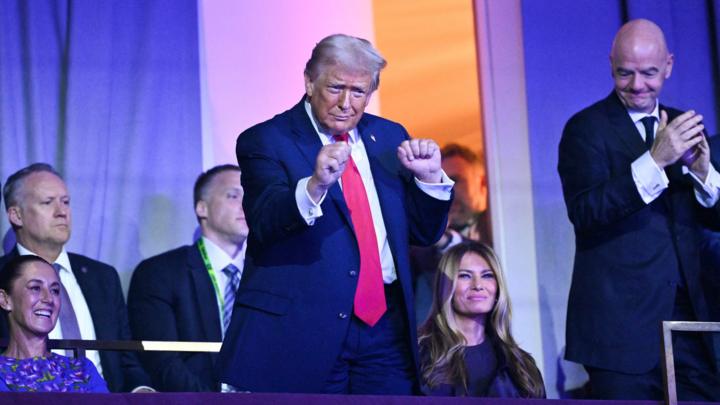 Image source, Getty Images
US President Donald Trump was on his feet dancing along to the Village People's rendition of YMCA at the end of the World Cup draw
ByBrendon Mitchell
BBC Sport journalist
Next summer's World Cup, at long last, is starting to feel very real.
But, while fans of the home nations can finally start marking their calendars and plotting routes through the tournament, Friday's draw in Washington DC was not short of other major talking points.
Long before the Village People took to the stage to sing us out with a rendition of YMCA, we were left picking the bones out of a group stage which will see two of the world's best strikers go head-to-head and a knockout stage which could produce a truly mouthwatering meeting between two greats of the game.
Are you excited yet?
BBC Sport talks you through the best - and worst - of a World Cup draw which went on, and on, and on...
The draw that seemed like it may never end
Many people tuned into the BBC's coverage bang on 17:00 GMT, eager to find out who their teams would be playing in the group stage of next year's tournament.
But, even though supporters should, by now, be well accustomed to these draws taking some time to get going... this was extraordinary.
After performances by Robbie Williams and former Pussycat Dolls singer Nicole Scherzinger, speeches from US President Donald Trump and Fifa counterpart Gianni Infantino, plus numerous montages, cutaways and interviews, it finally seemed to get going at 17:55 GMT. Or so we thought.
Mexico President Claudia Sheinbaum and Canada Prime Minister Mark Carney joined Trump on stage to pick their respective countries, as co-hosts, out of the hat. But this was not new news.
Cue more interviews and performances, before the actual draw eventually began at 18:27 GMT - nearly an hour and a half after the star-studded show first kicked off.
The draw itself then took 59 minutes to complete, with BBC commentator Jonathan Pearce even quipping at one point that everything was taking so long to get through, the tournament would be upon us by the time the ceremony had been wrapped up.
Donald Trump receives inaugural Fifa Peace Prize
Next summer's World Cup will the biggest in the competition's history, with a record 48 teams taking part and a round of 32 being introduced for the first time.
But this has perhaps led to the group stage - with 12 groups each containing four teams - being slightly diluted in quality.
There are very few matches between the major nations. England's game against Croatia - a repeat of the 2018 semi-final - is the most significant on paper.
That is the only group fixture which will see two teams ranked in the top 10 in the world come up against one another.
Brazil (fifth) v Morocco (11th) in Group C is the next best.
Netherlands have the toughest group in terms of Fifa world rankings, drawn against Japan, Tunisia and one of the play-off winners, while Germany - grouped with Ecuador, Ivory Coast and Curacao - have the weakest.
But that doesn't mean there aren't still some interesting matches to look forward.
Tuchel reacts to England's 'difficult' World Cup group
Two goal machines go head-to-head
Generational goalgetter Erling Haaland will get a crack at his first major tournament next summer.
The Manchester City and Norway striker scored 16 times in eight World Cup qualifiers to drag his country to their first appearance in the competition since 1998.
And 'drag' is no exaggeration - no player, across any continent, scored more in qualifying than Haaland. No wonder one Norwegian journalist went as far as suggesting "there's already a case to be made that he's our greatest ever player".
Few have managed to even come close to the 25-year-old's ridiculous goalscoring feats in recent seasons - but someone who has is set to come up against him in the final round of group games.
Along with Senegal and one of the play-off winners, Norway have been drawn against Kylian Mbappe's France in Group I.
It means the top marksmen in the Premier League and La Liga will go head-to-head for the first time in international football.
Mbappe, just two goals away from becoming France's record scorer at the age of 26, has scored 16 times in 15 league games this season for Real Madrid. Haaland, already Norway's record scorer and a whopping 22 goals clear of the next best, has scored 15 in 14 for City.
Expect goals. Lots of goals.
We meet again
Mexico will take on South Africa at Estadio Azteca in the opening match of next summer's World Cup - and not for the first time.
The two teams also opened the 2010 edition, which was hosted by South Africa - the first time the competition had been held in the continent.
The game, which ended 1-1, is best remembered for Siphiwe Tshabalala's rasping second-half strike to put Bafana Bafana in front. It was an iconic World Cup goal.
Another eye-catching group game will see France again come up against Senegal, who stunned the then-world champions in 2002 in one of the tournament's most famous shocks.
On the opening night in Seoul, South Korea, future Fulham midfielder Papa Bouba Diop upstaged France's cast of star names to score the decisive first goal of the tournament after 30 minutes.
France never recovered, failing to win any of their games and finishing bottom of the group.
Dream ties for the debutants
Uzbekistan, Cape Verde, Jordan and Curacao have all taken advantage of the expanded World Cup by qualifying for the finals for the first time.
But standing in their way are former world champions, European champions and champions of South America.
In Group E Curacao, the tiny Caribbean island who will become the smallest nation to play at a World Cup, will take on four-time World Cup winners Germany in their first-ever finals match.
With a population of around 600,000, Cape Verde may well have been pinching themselves when they were drawn alongside European champions and World Cup winners Spain in Group H. They will take on the 2010 winners in their opening game.
Jordan took part in qualifying for the first time 40 years ago and their reward for reaching their first World Cup is a tie with defending champions Argentina and Lionel Messi in Group J.
And, in Group K, Italy's 2006 World Cup winner Fabio Cannavaro will guide Uzbekistan into their first finals, where they will face Cristiano Ronaldo's Portugal.
What about the knockout stage?
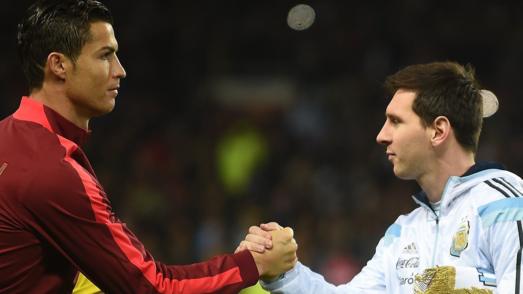 Image source, Getty Images
Could Cristiano Ronaldo and Lionel Messi - pictured here before a friendly between Portugal and Argentina in 2014 - meet on the international stage again?
Assuming all the top teams make it safely through their groups - a dangerous assumption, admittedly - we shouldn't have to wait too long for some of the big hitters to collide.
It is in the last 16 where things could get really tasty, most notably with a potential tie between former champions Germany and France.
The pair last met in a World Cup at the quarter-final stage in 2014, with Mats Hummels' early header enough to send the Germans through.
If Germany come out on top again they would have to contend with the Netherlands and Spain if they are to reach the final - a very tough run having ended up in the most straightforward group.
On the other side of the draw, eyes will instantly be drawn to the quarter-final stage, with old rivals Messi and Ronaldo set for a possible showdown.
It would depend on both Argentina and Portugal finishing top of their respective groups and then squeezing through the last 32 and 16 but, if they are able to do that, it would be a remarkable way to mark the pair's final World Cups.
For England, a game against co-hosts Mexico seems the most likely last-32 tie, providing the Three Lions top their group.
And, if Scotland are able to get through, Japan or the Netherlands could be waiting for them in what would be their first ever World Cup knockout fixture.
'Bring it on' - Clarke releshing chance at World Cup after draw




 English (US) ·