
 3 hours ago
2
3 hours ago
2

Chris MasonPolitical editor

 EPA
EPA
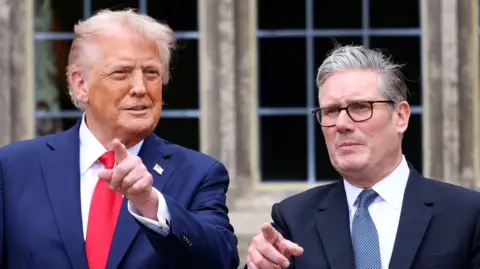
Just yesterday, the prime minister made the case for "calm discussion" with the United States.
He wakes up this morning to President Trump personifying a political Catherine wheel: spinning, unpredictable, colourful and firing off reactions at every angle.
Every angle, including in the direction of the UK, and in particular Sir Keir Starmer.
This moment, like no other before it, poses a massive strategic question for Sir Keir: What on earth to do now?
He has courted Donald Trump and built his foreign policy around being seen to be a dependable, trustworthy ally of the president, who wouldn't sound off about him in public.
In an extraordinarily difficult start for his government at home, Sir Keir's relationship with the US president was widely seen as an unlikely success story.
Trump spoke very warmly of the prime minister in public, and Downing Street believed it had a stronger relationship with the White House than many European allies - and that was to the UK's benefit.
The deal the government did over the president's tariffs last year was talked up as a case study in the advantages of the relationship they had built.
But now this. Firstly Greenland, now the Chagos Islands.
The government is defending its deal to hand over the islands to Mauritius, announced last year, following President Trump's splenetic outrage about it on social media.
Senior sources are making it clear there were very good reasons for the deal, and point out that it was publicly welcomed by the United States and Australia - two countries, alongside the UK, that are part of the 'Five Eyes' intelligence alliance.
The argument ministers have long made is that legal challenges over the validity of the UK's claim to the Chagos Islands threatened the viability of the crucial military base on Diego Garcia - a site prized by both the UK and the US.
The deal they did, they say, secures the long-term future of the base.
Change of heart
It is almost a year since the president's view on the deal was first sought in public.
I remember it - I was there, in the Oval Office of the White House.
The reporter pack suspected the president might be sceptical about it. But we were wrong. When we asked, he sounded supportive.
A few months later, last May, when the deal was formally done, it was welcomed by the United States.
But now we see this colossal change of heart - delivered in a characteristic blitz of capital letters.
And this might not be the end of it, even this week.
A decision is imminent on a new Chinese embassy in London, something Beijing has long coveted and critics have long said would be a big mistake and a security risk.
I know from conversations I have had there are deep reservations in Washington about the UK being seen to cosy up, as they see it, to China.
Could approval of a new embassy, just a few weeks before the prime minister is expected to visit China, be the next stimulus for presidential outrage?
That feels entirely possible, right now.


 English (US) ·