
 3 hours ago
1
3 hours ago
1

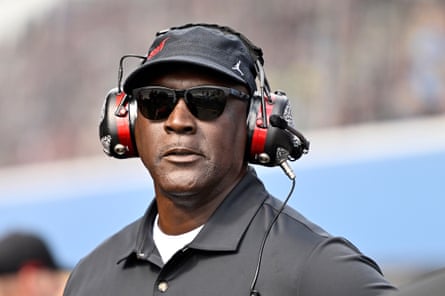
Michael Jordan took the stand on Friday in his landmark antitrust fight against Nascar, a case that could reshape how one of America’s biggest sports is run. Jordan’s team, 23XI Racing, and Front Row Motorsports say Nascar holds so much control over everything, from the tracks to the money to the rulebook, that teams have no real bargaining power. Nascar denies that and says the lawsuit threatens to blow up a system that has held the sport together for decades.
The case has already pulled blunt internal messages into public view and laid bare long-running frustrations between teams and Nascar leadership. Denny Hamlin, Jordan’s co-owner, has said the trial will finally “hear the truth” about how the series “really operates”.
So what is this case actually about? Here’s the simplified version …
What’s going on?
Michael Jordan – yes, that Michael Jordan – co-owns 23XI Racing with three-time Daytona 500 winner Denny Hamlin. Together they’ve built one of Nascar’s strongest young teams. But Jordan says the business model underpinning America’s top motorsport is fundamentally imbalanced.
Jordan says Nascar isn’t playing fair with a system that determines who gets guaranteed entry into races, how much money they make and even the tracks where the races are held – a system so central to team survival that it can make or break an entire organization.
That system revolves around something called a charter. And that’s where the fight begins.
What exactly is a charter?
A charter is like a golden ticket that guarantees your team can race each week. Only a limited number exist. Teams bought them years ago for a few million dollars and their value skyrocketed into to the tens of millions because they essentially secure your place in the sport. The most recent sale went for about $45m (£33.7m).
But here’s the catch: the charters expire and can be renewed only on Nascar’s terms. It’s like if you bought an ice-cream truck permit in 2016 for $5, and in 2025 the city tells you: “Oh, by the way, your permit expires now. Renew it on our terms or else.”
Jordan does not love that.
Fifteen teams were offered new multi-year charter agreements in 2024, after more than two years of tense negotiations. Thirteen eventually signed. Jordan’s 23XI Racing and Bob Jenkins’ Front Row Motorsports did not, arguing the terms fell far short of what teams needed for financial stability and long-term growth.
Both teams competed in 2024 as “open” entries – permitted under Nascar rules but without guaranteed purse payouts – which they say cost them millions.
What is Jordan’s beef?
Jordan’s basic complaint is that teams are being asked to spend huge sums of money without getting anything solid in return. He says he’s personally invested $40m (£29.9m) into 23XI Racing, but Nascar still controls whether his team has a guaranteed spot on the grid from year to year.
In Jordan’s view, that means he doesn’t really own his place in the sport. Nascar does.
It’s like buying a house and then having the landlord show up to say: “Actually, this is still mine. You’ll need to re-apply every few years if you want to keep living here.”
Teams want charters to function the way franchise rights do in the NBA or NFL: permanent, transferable and worth whatever the open market will pay. Right now, they say Nascar can change the rules whenever it wants, which makes their investment feel shaky and unsafe.
What is Nascar’s defense?
Nascar, founded 76 years ago by the France family, insists it has violated no antitrust laws and says its charter negotiations reflected standard commercial practice.
The series argues the 2025 agreement actually increased payouts to teams and that the ability for cars to compete as open entries shows the system is not anti-competitive. Nascar also points to extensive support from other team owners, including declarations from Rick Hendrick and Roger Penske, who do not want the charter model dismantled.
Pretrial filings also revealed Nascar earned more than $100m in 2024, a figure the suing teams argue underscores the imbalance in bargaining power.
Why was the discovery process so explosive?
Because the lawsuit opened the door for lawyers to seize emails, texts and internal messages from both sides, many of which were never meant to be public.
Among the disclosures:
-
Nascar executives called Hall of Fame owner Richard Childress a “dinosaur”, an “idiot”, and a “stupid redneck”, with one saying he should be “taken out back and flogged”
-
Another executive claimed Nascar fans “can’t read”
-
Leaders discussed trying to “kill” Tony Stewart’s SRX short-track series because Cup drivers were participating
-
A 23XI president joked that Nascar chairman Jim France “had to die” before teams would get better charter terms
-
Hamlin said he disliked the France family
-
One Jordan adviser wrote that Hamlin was not a good businessman
-
Jordan himself joked he loses more money in a casino than he pays one of his drivers
The revelations have deepened mistrust between Nascar and several high-profile figures in the garage.
Who is appearing in court?
Jordan received permission to attend the entire trial – a rarity for a party in a civil case – and is expected to be the most visible presence for the plaintiffs. On Friday, he took the stand and described a lifelong love of racing and a desire for a fairer partnership with Nascar. He insisted he doesn’t want to destroy the sport, but said the lawsuit is “for every person in Nascar … that isn’t being treated fairly”.
Hamlin has testified that teams are being squeezed by rising costs and a charter system that leaves “only one side going out of business”. He acknowledged 23XI has turned profits but said that’s only possible because Jordan can attract sponsors, arguing the model isn’t sustainable for most teams.
Front Row Motorsports owner Bob Jenkins detailed more than $60m in cumulative losses and sharp cost increases under the Next Gen car, while Nascar president Steve O’Donnell defended the series’ record, noting nine-figure profits but also losses on high-profile events in Chicago, Los Angeles and Mexico City that he framed as investments in growth.
Joe Gibbs Racing co-owner Heather Gibbs told the jury she felt forced to sign the 2025–31 charter deal under a last-minute deadline, saying it was like having “a gun to your head” when hundreds of jobs and her late husband’s legacy were on the line.
How big are the potential consequences?
Massive. If Jordan and Front Row win, the jury will decide monetary damages. US district judge Kenneth Bell can adjust the amount, including tripling it under antitrust law. More dramatically, if a monopoly is found, the court could order structural remedies.
Those could include:
-
forcing the France family to sell Nascar or the tracks it owns
-
mandating permanent charters
-
restructuring or even dismantling the current charter system
-
rewriting elements of Nascar’s governance
If Nascar prevails, 23XI and Front Row may struggle to continue operating beyond 2026. The six unassigned charters held aside for the next agreement would likely be sold, with private equity firms among prospective buyers.
What happens next?
The trial is expected to run for another week in the Western District of North Carolina. A settlement remains possible at any time, including after a jury verdict, and either side could appeal.
Whatever the outcome, the case has cracked open long-simmering resentments inside the sport and raised existential questions about its future. Jordan’s presence alone underscores how high the stakes have become and how far the fight over Nascar’s economic model now extends.







 English (US) ·